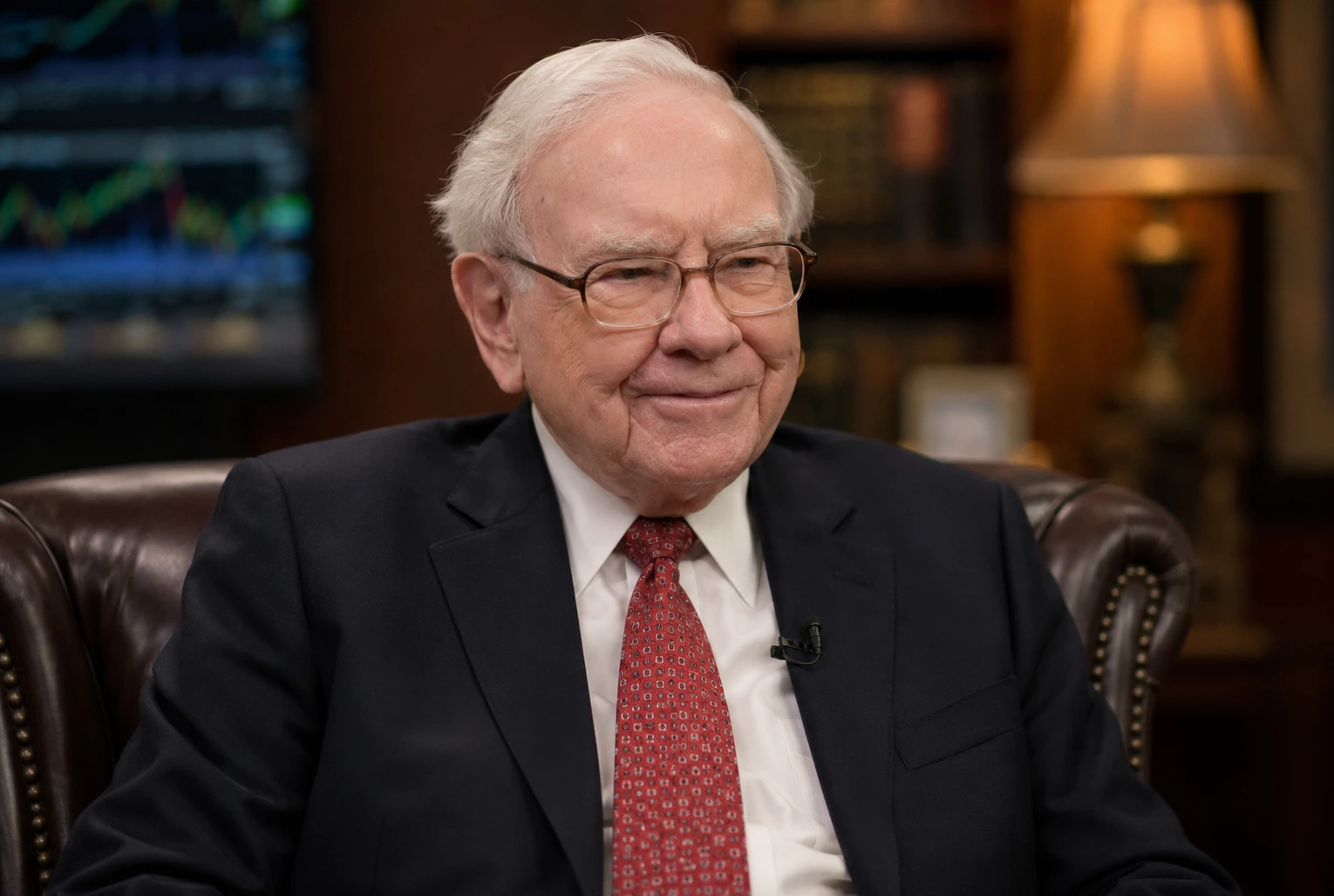
Warren Buffett: Biography
Warren Edward Buffett is an American investor, businessman, and philanthropist who is widely regarded as one of the greatest long-term investors in modern financial history. Known as the “Oracle of Omaha,” he built his reputation through Value Investing, disciplined capital allocation, and the patient acquisition of high-quality businesses.
Buffett served for decades as Chief Executive Officer of Berkshire Hathaway and remains closely associated with the company as its chairman. After stepping down as CEO, he was succeeded by Greg Abel.
Although Buffett is primarily a long-term equity investor rather than a Forex trader, his principles concerning risk, market psychology, patience, and capital preservation remain highly relevant to currency traders.
Early Life
Warren Buffett was born on August 30, 1930, in Omaha, Nebraska. His father, Howard Buffett, was a businessman, stockbroker, and member of the United States Congress.
Buffett showed an interest in business and numbers from an early age. As a child, he sold chewing gum, soft drinks, and magazines. He also delivered newspapers and searched for small business opportunities that could generate recurring income.
One of his earliest investments was the purchase of shares in Cities Service Preferred when he was 11 years old. The experience introduced him to both market volatility and the emotional pressure of holding an investment while its price moved against him.
Education
Buffett initially attended the Wharton School at the University of Pennsylvania before transferring to the University of Nebraska, where he completed his undergraduate studies.
He later earned a graduate degree from Columbia Business School. At Columbia, he studied under Benjamin Graham, the economist and investor commonly regarded as the father of Value Investing.
Graham’s ideas had a profound influence on Buffett. He taught that investors should evaluate the intrinsic value of a business and buy only when the market price provides an adequate Margin of Safety.
Working with Benjamin Graham
After completing his studies, Buffett wanted to work for Benjamin Graham’s investment firm. Graham initially declined to hire him, but Buffett eventually joined Graham-Newman Corporation in 1954.
While working there, Buffett gained practical experience in analysing financial statements, identifying undervalued securities, and separating a company’s fundamental value from short-term market sentiment.
When Graham retired, Buffett returned to Omaha and began managing capital independently.
Buffett Partnership Ltd.
In 1956, Buffett established Buffett Partnership Ltd., using capital provided by family members, friends, and business associates.
His early investment approach closely followed Benjamin Graham’s strategy. Buffett searched for companies whose shares traded below the estimated value of their assets or future cash flows.
He was not interested in buying a stock simply because its price was rising. Instead, he viewed each share as partial ownership of a real business.
The success of the partnerships allowed Buffett to accumulate capital and eventually take control of Berkshire Hathaway.
Acquiring Berkshire Hathaway
Berkshire Hathaway was originally a struggling textile manufacturer. Buffett began buying its shares because he believed they were undervalued.
He eventually gained control of the company, but later acknowledged that purchasing the textile business was not one of his best decisions. The textile industry required substantial capital while producing weak returns.
Instead of abandoning Berkshire, Buffett gradually transformed it into a diversified holding company. Capital generated by its businesses was redirected into insurance, energy, transportation, manufacturing, retail operations, and marketable securities.
Under Buffett’s leadership, Berkshire Hathaway became one of the world’s most prominent corporate groups.
Partnership with Charlie Munger
Charlie Munger became Buffett’s closest business partner and served for many years as Berkshire Hathaway’s vice-chairman.
Munger helped Buffett expand his investment philosophy beyond purchasing statistically cheap companies. Together, they increasingly focused on buying outstanding businesses at reasonable prices rather than mediocre businesses at extremely low prices.
This shift became a defining feature of Berkshire Hathaway’s strategy.
Buffett and Munger looked for companies with:
- Durable Competitive Advantages
- Strong and trustworthy management
- Consistent cash flow
- High Returns on Capital
- Manageable debt
- Predictable long-term economics
Their partnership became one of the most influential collaborations in investment history.
Warren Buffett’s Investment Philosophy
Buffett’s investment philosophy is based on understanding businesses rather than predicting short-term price movements.
Value Investing
Value Investing involves estimating an asset’s Intrinsic Value and comparing it with the current market price.
When a high-quality company trades below what Buffett believes it is worth, the difference may provide a Margin of Safety.
However, a low share price alone does not make a company attractive. Buffett also considers the company’s business model, management quality, competitive position, profitability, and long-term growth potential.
The Circle of Competence
Buffett believes investors should operate within their Circle of Competence.
This means investing only in businesses or markets that they genuinely understand. An investor does not need to understand every industry. What matters is recognising the limits of one’s knowledge.
For Forex traders, the same principle may involve specialising in a limited number of Currency Pairs, economic indicators, or Trading Sessions rather than attempting to trade every market.
Long-Term Investing
Buffett prefers businesses that can generate value over many years.
Instead of trying to profit from every short-term fluctuation, he focuses on the long-term earning power of a company.
This allows Compounding to work over extended periods. When profits are reinvested successfully, the value of the investment may grow at an increasing rate.
Buffett’s approach shows that patience is not inactivity. It is the discipline to wait for an attractive opportunity and allow a strong investment thesis to develop.
Margin of Safety
The Margin of Safety is the difference between an asset’s estimated Intrinsic Value and its market price.
Because every valuation contains uncertainty, Buffett avoids paying a price that assumes everything will develop perfectly.
A wider Margin of Safety provides greater protection against analytical errors, unexpected economic changes, and market volatility.
In Forex trading, a comparable principle is avoiding entries where the potential reward is too small relative to the possible loss.
Capital Preservation
Buffett places enormous importance on avoiding permanent capital loss.
Temporary Drawdowns and market volatility are not necessarily permanent losses. A permanent loss occurs when an investor buys an asset with weak fundamentals, uses excessive leverage, or is forced to sell at an unfavourable time.
This principle is highly relevant to Forex traders because leverage can magnify both profits and losses. Even a strong analysis can fail when Position Size is too large.
Market Psychology
Buffett recognises that financial markets are strongly influenced by fear and greed.
During Bull Markets, investors may become overconfident and pay excessive prices. During Bear Markets, fear may cause them to sell valuable assets below reasonable levels.
Buffett attempts to behave independently of the crowd. He becomes more cautious when investors are excessively optimistic and more interested when widespread fear creates attractive valuations.
For traders, the lesson is not to enter a Buy position simply because price is rising or a Sell position simply because price is falling. Market Sentiment should be evaluated together with Fundamentals, Price Action, and Risk Management.
Avoiding Excessive Leverage
Buffett has consistently warned about the risks of excessive debt and leverage.
Leverage may increase returns when a position moves in the expected direction, but it can also force an investor out of a strong long-term position during temporary volatility.
Forex traders face the same danger. High leverage, oversized Lot Sizes, and insufficient Free Margin can cause a Margin Call or Stop Out before the original analysis has time to develop.
Berkshire Hathaway’s Business Model
Berkshire Hathaway owns and invests in businesses across many industries.
A central part of its model is the insurance business. Insurance companies collect premiums before claims are paid, creating funds known as Float.
When managed responsibly, this Float can be invested until it is needed to pay claims. Buffett used Berkshire’s growing insurance Float as an important source of investment capital.
Berkshire also developed a reputation for allowing acquired companies to operate with considerable independence. Managers were expected to run their businesses effectively, while Buffett focused primarily on capital allocation.
Approach to Economic Forecasting
Buffett pays attention to economic conditions but does not normally base long-term investment decisions on precise forecasts of interest rates, inflation, currencies, or GDP.
He believes that macroeconomic predictions are extremely difficult to make consistently.
Instead, he focuses on acquiring productive assets that can remain valuable across different economic environments.
For Forex traders, this does not mean ignoring economic data. Currency prices are directly affected by inflation, central-bank policy, employment, and interest-rate expectations. However, Buffett’s philosophy suggests that traders should avoid becoming overconfident in any single forecast.
Warren Buffett and Gold
Buffett has historically preferred productive assets—such as businesses, farms, and real estate—over assets that do not generate cash flow.
Gold may preserve purchasing power and perform well during inflation, geopolitical tension, or financial uncertainty, but it does not produce earnings or dividends.
This differs from the perspective of many XAU/USD traders, who focus on shorter-term price movements driven by the US dollar, Treasury yields, Federal Reserve policy, Safe-Haven demand, and Market Sentiment.
The contrast illustrates an important distinction between long-term investing and active trading. An asset may not meet Buffett’s long-term investment criteria but may still provide valid trading opportunities.
Philanthropy
Buffett has committed most of his wealth to philanthropy.
In 2010, he joined Bill Gates and Melinda French Gates in launching the Giving Pledge, an initiative encouraging wealthy individuals and families to donate the majority of their fortunes to charitable causes.
His philanthropic activities have supported education, health, poverty reduction, and family-run charitable foundations.
Lessons Forex Traders Can Learn from Warren Buffett
Protect Trading Capital
The first priority is to remain financially capable of taking future opportunities. One oversized trade should never be allowed to destroy an account.
Wait for High-Quality Setups
Buffett does not invest simply because the market is open. Forex traders likewise do not need to enter a position every day.
Stay Within Your Circle of Competence
Focus on Currency Pairs, Trading Sessions, and strategies that you understand thoroughly.
Avoid Excessive Leverage
A good market view combined with excessive leverage can still produce a disastrous result.
Think Independently
Do not follow the crowd without analysis. Evaluate Fundamental Data, Market Structure, liquidity, and Price Action before entering a trade.
Control Emotions
Fear and greed can cause traders to close winning positions too early, hold losing positions too long, or abandon their Trading Plan.
Focus on Risk-to-Reward
A trade should offer enough potential return to justify the capital being risked. A favourable entry provides a form of Margin of Safety.
Legacy
Warren Buffett’s legacy extends far beyond his personal wealth.
He demonstrated that extraordinary long-term results could be achieved through patience, rational decision-making, disciplined capital allocation, and a deep understanding of business fundamentals.
Rather than relying on constant trading, complicated indicators, or short-term predictions, he focused on buying valuable assets at sensible prices and allowing Compounding to work over time.
His career also showed the importance of integrity, reputation, and strong partnerships. Together with Charlie Munger, Buffett helped establish a practical investment framework studied by investors around the world.
Conclusion
Warren Buffett’s journey from a young entrepreneur in Omaha to one of the most influential investors in financial history demonstrates the power of patience, discipline, and long-term thinking.
His approach is built around Value Investing, Intrinsic Value, Margin of Safety, capital preservation, and emotional control.
Although Buffett is not primarily a Forex trader, his principles remain highly applicable to currency markets. Forex traders can benefit from waiting for high-quality setups, controlling Position Size, avoiding excessive leverage, remaining independent of crowd psychology, and protecting capital above all else.
His most enduring lesson is that success in financial markets does not come from acting constantly. It comes from acting rationally when the right opportunity appears.
About the Author